One of my current projects has a complex and tangled package hierarchy. That made me ask myself: if I were designing a new application on the platform from scratch, which approach would I choose?
I'm a big fan of DDD, so I started thinking about how to split schemas so that each package represents an architectural layer of the application, while still keeping development convenient for both no-code and hard-code developers.
A simple split by schema type doesn't work: objects, pages and business processes can depend on each other cyclically. So some schemas have to be split or partially duplicated across packages to keep the hierarchy acyclic. Source code could, of course, be made fully independent of everything else, but that doesn't guarantee stability: code often depends on system settings and populated lookups. Isolating it completely at the very bottom of the hierarchy didn't seem like the best idea either.
I won't walk you through my whole thought process, so let's get straight to the point. The architecture below is my personal preference. I don't claim it's the only right answer (otherwise there would be no question mark in the title). It's the result of my reasoning, my experience, and the pain I'd like to minimize when a release with critical bugs has to be rolled back, without breaking the overall CI/CD approach.
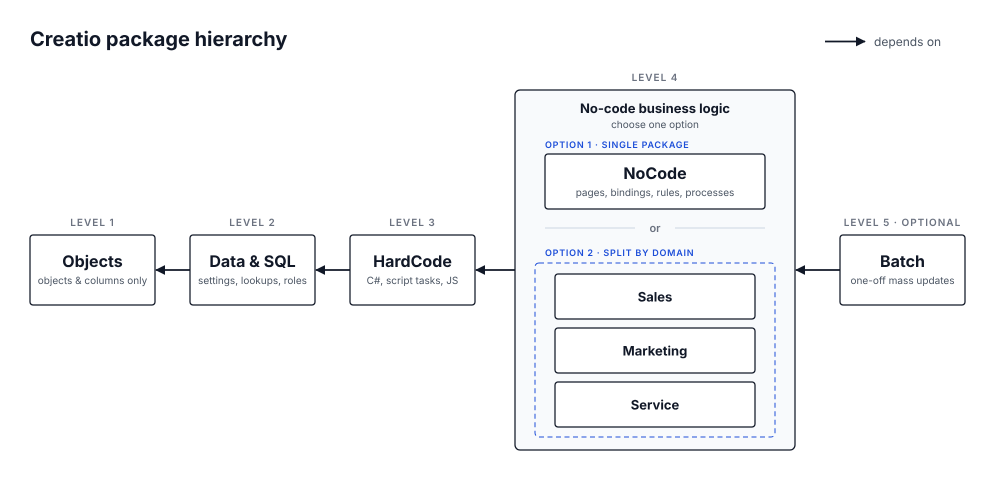
The diagram shows the overall structure. Below I go through it level by level, top to bottom, and explain each decision.
Level 1 — Data model
The package that all packages below depend on. It contains only objects and their columns, and nothing else: no filters, no default values, no required flags.
Why:
• Rollback. If a critical bug reaches production but users have already filled in new columns or tables, we can roll back the business logic (processes, pages) without losing their data.
• Ownership. This package can be entrusted to a more experienced analyst who won't create columns only to delete them later, who pays attention to the data model and takes responsibility for it. New analysts often struggle here, and the data model ends up cluttered with junk columns and objects with default names.
Level 2 — Data and SQL
Data bindings and SQL scripts: system settings, lookup values, roles, SQL scripts. It sits at level 2 because it depends only on the database structure (Level 1), while business processes, source code and column default values depend on it.
A separate data package also lets you quickly move data from dev/test to production when new lookup values are needed. Or the other way around: if someone created roles or lookup values directly on production, by accident or on purpose, you can bring them back to dev without breaking data integrity. Yes, that happens too. Rarely, but it does.
Level 3 — Source code
Business processes with script tasks, user tasks, source code, Angular components, JS modules. All of this essentially depends only on data and the database structure.
Why:
• Hard-code developers get a simpler workflow: the whole project's code can be compiled locally into a single DLL.
• On deployment we know exactly which package to compile to apply the new code. When source code is scattered across several packages, you either have to guess where a schema lives or compile the entire system, which simply takes longer.
Level 4 — No-code business logic
There are two options, depending on the size of your project.
Option 1: a single package containing object replacements (no new columns) with column business rules and default values, pages and their bindings, business processes without script tasks, add-ons, cases, marketing campaigns and no-code web services. This is the analyst's main workspace, where all no-code business logic lives. It depends on all three packages above and acts as an interface layer: business rules and processes only invoke the source code and define how everything is connected.
Page bindings live here, next to the pages they point to, rather than in the data package. A binding depends on its page, so keeping them together means that rolling back this level never leaves bindings pointing to pages that no longer exist.
Option 2: the same idea, split into several packages by domain or application area, for example Sales, Marketing, Service, CRM. Each package has the same internal structure as in option 1, but contains only the logic for its part of the application, or overrides a specific part of the base platform.
Level 5 — Batch processes (optional)
The last, optional level for one-off batch processes used for mass data updates when needed.
Scaling to large projects
Of course, on a very large project you may end up with packages that contain a lot of schemas. But that is the natural outcome of practically any architecture. Nothing stops you from applying this approach several times: if your project consists of several applications, each of them can have its own hierarchy built the same way.
If you've read this far, you probably care about clean architecture on the platform as much as I do. So please leave a comment: challenge it, criticize it. As I said, I don't claim to have the final answer, and I'd genuinely like to hear other perspectives and think about what I could improve. Thanks!